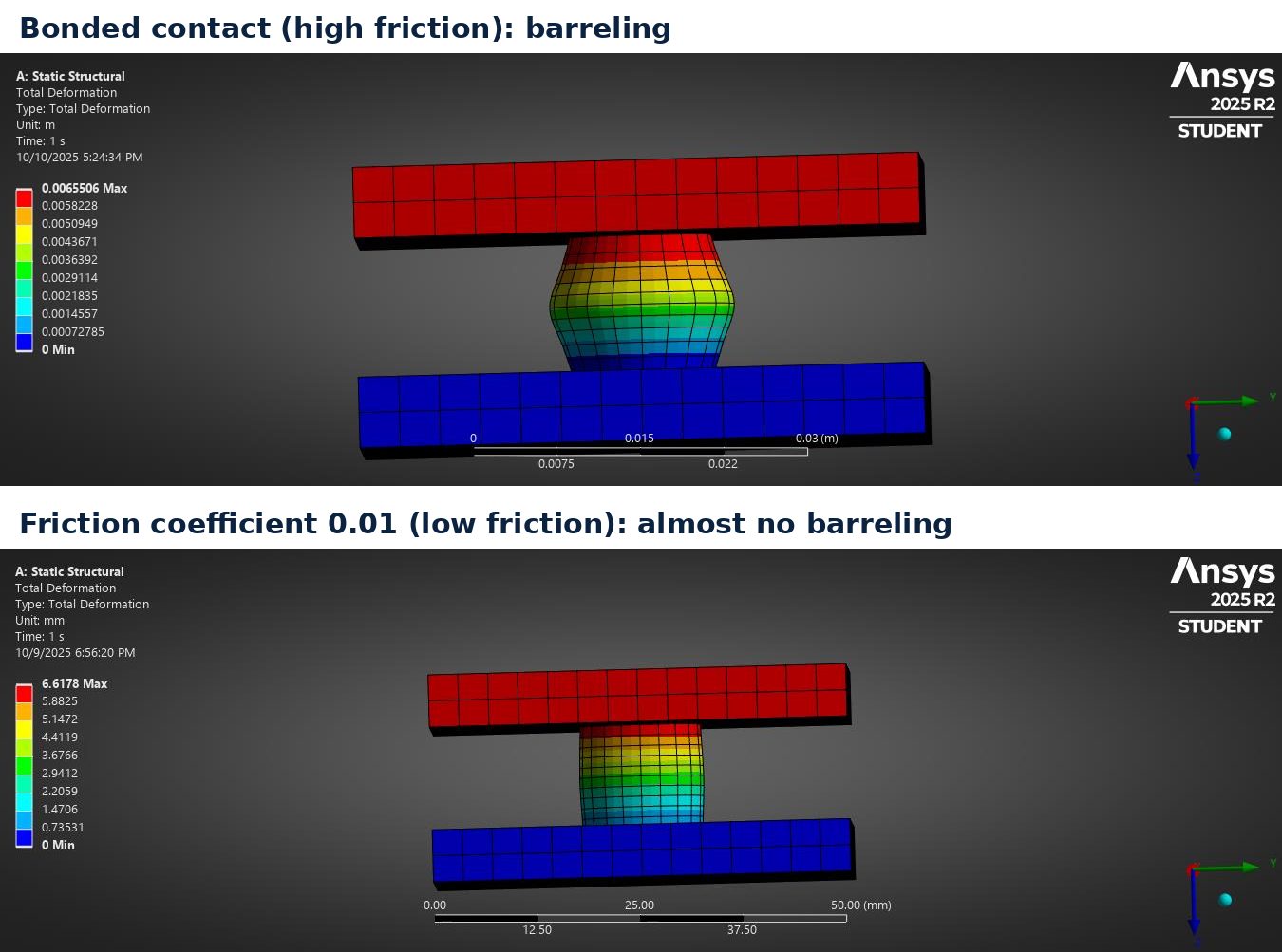
With bonded (very high friction) contact, the middle of the billet bulged wider than its ends. This is called barreling.
With a friction coefficient of 0.01, the middle stayed almost the same width as the ends.
Conclusion: friction between the dies and the part drives barreling.
University of Alabama at Birmingham · MSE 401, individual homework · Fall 2025
Role
Individual class assignment: I built the CAD model, set up the simulation, and wrote up the results.
Challenge
Simulate forging a heated aluminum billet between two steel dies, and show what causes the billet to barrel (bulge in the middle) as it is squashed.
What I did
CAD (SolidWorks): Modeled a ½ in diameter × ¾ in tall aluminum cylinder between two 2 × 2 × ¼ in steel dies, a fixed lower die and a moving upper die, with every body split so the simulation would run.
Material data: In ANSYS Workbench Static Structural, entered true stress-strain data for heated aluminum by hand (in MPa; the wrong units crash the solver with an overflow error). The dies used ANSYS’s standard structural steel.
Two friction cases: Bonded contact between dies and billet to model extreme friction, and a friction coefficient of 0.01 to model very low friction.
Mesh and motion: 20 mm mesh on the dies and 2.0 mm on the billet. Moved the upper die 6.35 mm down to compress the billet.
Results
High friction (bonded): the middle of the billet ended up much wider than where it touched the dies. That’s barreling, caused by friction at the dies and within the hot aluminum itself.
Low friction (0.01): the middle stayed nearly the same width as the top and bottom, with almost no barreling.
Comparing the two cases showed that friction is what causes barreling.